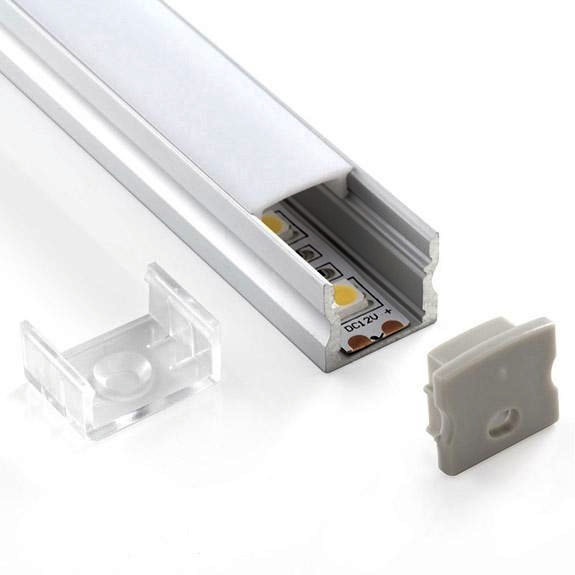
LED aluminum profiles are often used with different accessories to complete the installation. These accessories include end caps, mounting clips, spring clips, connectors and suspension kits.
Although these parts may look small, they play an important role in the final product. The right accessories help secure the profile, improve its appearance and make installation easier.
For distributors, wholesalers and lighting manufacturers, choosing the correct accessories is also important for product quality and long-term supply.
In this guide, we explain the main types of LED aluminum profile accessories, their materials, installation methods and compatibility requirements.
LED Aluminum Profile End Caps
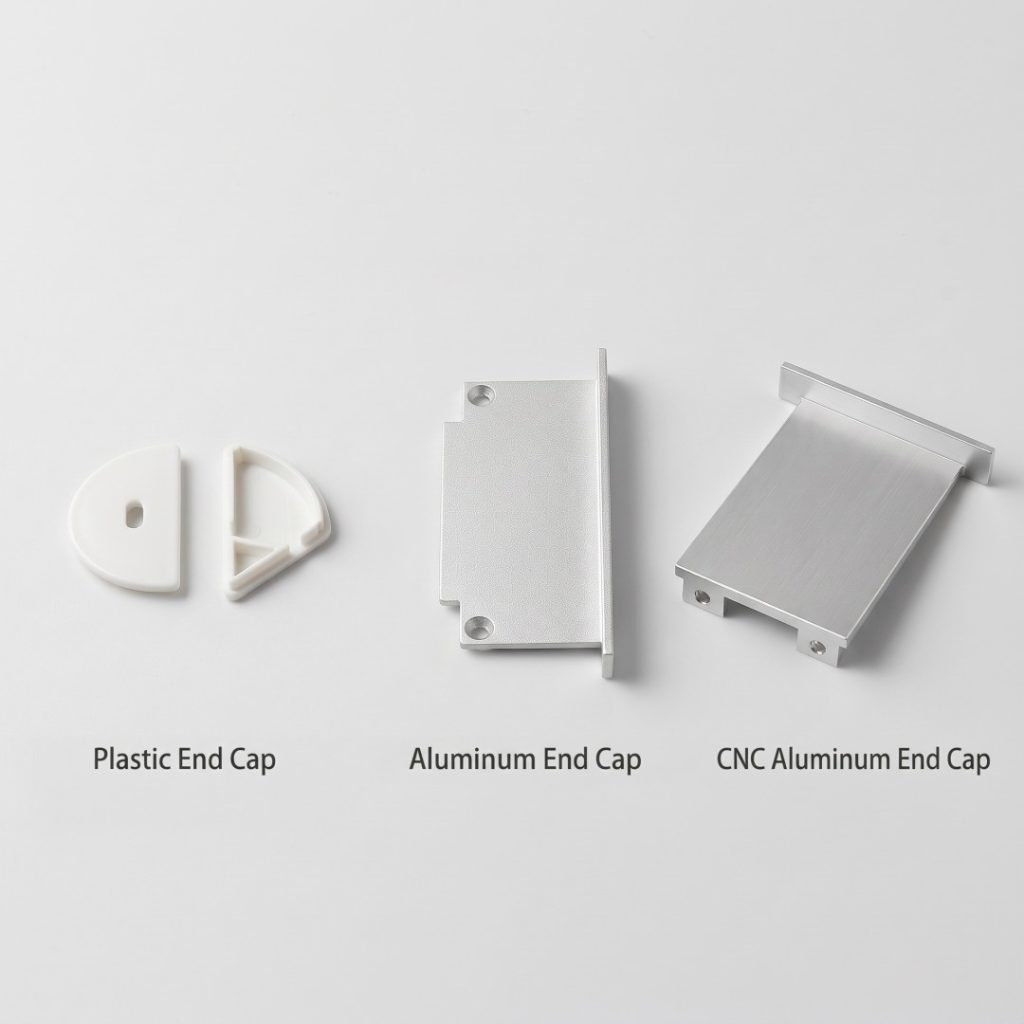
End caps are installed at the ends of LED aluminum profiles. They help close the profile, protect the internal components and create a cleaner appearance.
Different projects may require different end cap materials and fixing methods.
Plastic End Caps
Plastic end caps are widely used for LED aluminum profiles. They are usually fixed by friction, with the end cap fitting inside or around the profile.
Main features:
- Low production cost, especially for large orders.
- Suitable for injection molding and mass production.
- Available in different colors, including black and white.
- Can be designed with a light-blocking lip to reduce unwanted light escaping from the ends.
Plastic end caps are a practical choice for many standard LED profile products.
Aluminum End Caps
Aluminum end caps provide a metal finish that matches the aluminum profile.
They are commonly fixed with screws through the end cap or into a suitable fixing position on the profile.
Important points to consider:
- Accurate cutting is important for proper installation and appearance.
- The aluminum profile and diffuser should be cut to the same length when using standard aluminum end caps.
- Unlike CNC-machined end caps, conventional aluminum end caps generally cannot incorporate a custom light-blocking lip. If the diffuser extends beyond the aluminum profile, or the two parts are not properly aligned, light may leak from the end.
- The end cap fixing position and screw holes must match the profile design.
- Surface finishes can include black or silver anodizing, as well as black or white powder coating.
Aluminum end caps are suitable for projects that require a consistent metal appearance and a more integrated finish.
CNC Aluminum End Caps
CNC aluminum end caps are made by precision machining. They can support more customized structures and appearance requirements.
For example, an OEM design may include a hidden hex screw fixing structure. This can create a cleaner appearance without obvious external fixing screws.
Other possible features include:
- Custom shapes and dimensions.
- Hidden screw fixing.
- Special light-blocking structures.
- Custom surface finishes.
CNC aluminum end caps generally have the highest unit cost among the three types because of their machining requirements.
Comparison of End Cap Types
| Type | Fixing Method | Main Advantage | Cost Level |
|---|---|---|---|
| Plastic end cap | Friction fit | Low cost and suitable for mass production | Low |
| Aluminum end cap | Screw fixing | Matching metal appearance | Medium |
| CNC aluminum end cap | Customized hidden fixing | Flexible design and refined appearance | High |
End Caps With or Without Cable Holes
Not every LED profile requires a cable hole in the end cap.
The correct design depends on how the power cable exits the lighting product.
Common options include:
- Closed end caps: No cable opening, suitable when the wire exits from another position.
- Small cable holes: Suitable for a single thin wire.
- Larger cable holes: Suitable for thicker cables or multiple wires.
- Custom cable openings: Designed according to the cable position and product structure.
When selecting the cable hole size, consider not only the wire diameter but also the connector, cable sleeve and installation space.
End Cap Colors and OEM Options
End cap colors can be customized to match the aluminum profile and overall product design.
| Material | Available Options |
|---|---|
| Plastic | Black, white, gray and other material colors |
| Aluminum | Silver or black anodizing |
| Aluminum | Black or white powder coating |
| CNC aluminum | Customized shapes and finishes |
For OEM projects, the end cap structure, fixing method, color and light-blocking design can be adjusted according to the profile.
LED Channel Mounting Clips
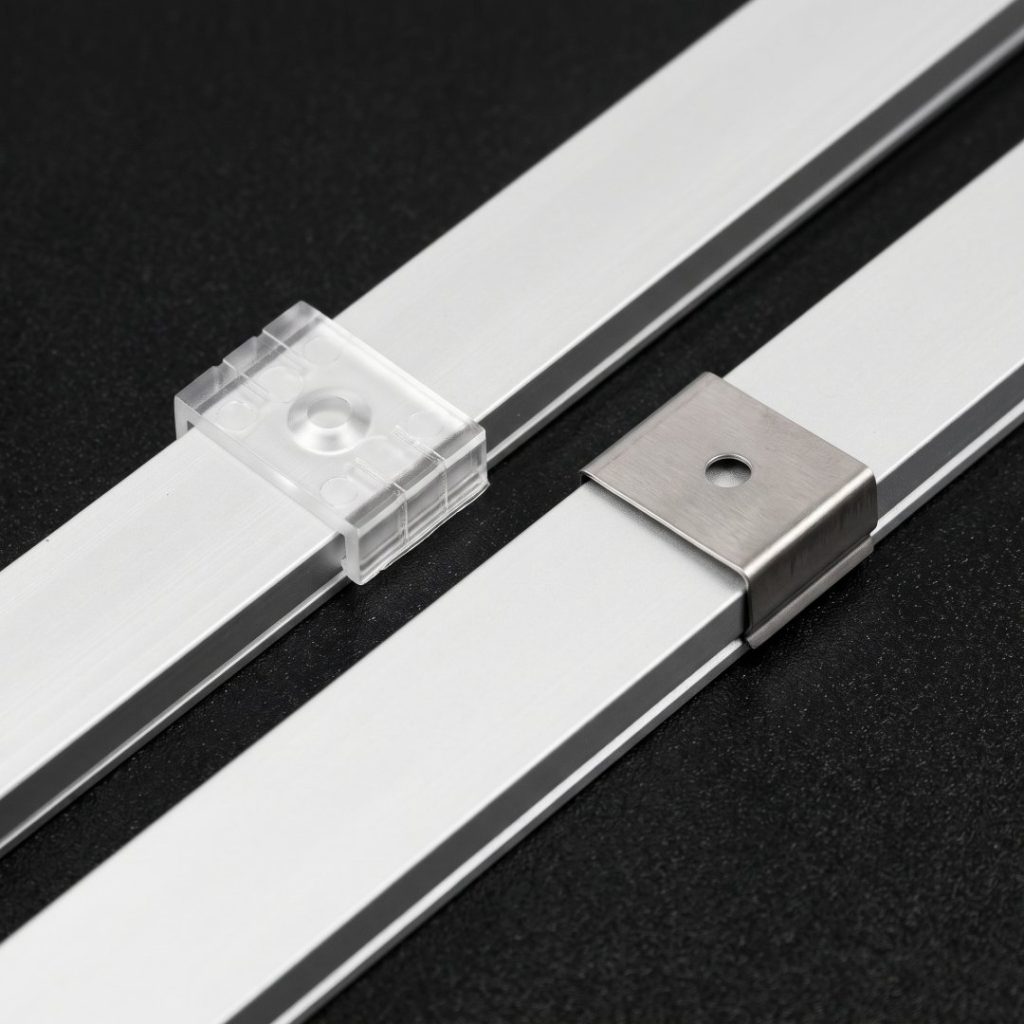
Mounting clips are commonly used to install surface-mounted LED aluminum profiles.
They are fixed to the installation surface with screws. The aluminum profile is then pressed or clipped into place.
The two common options are plastic mounting clips and metal mounting clips.
Transparent Plastic Mounting Clips
Transparent plastic mounting clips are widely used for surface-mounted LED profiles.
Their main advantages include:
- Transparent appearance, making the clips less noticeable after installation.
- Less risk of scratching the aluminum surface during adjustment.
- Flexible injection molding design.
- Can include countersunk screw holes for a more compact fixing structure.
- Suitable for mass production.
The countersunk screw design allows the screw head to sit below the clip surface, reducing interference during profile installation.
Stainless Steel Mounting Clips
Metal mounting clips are another option for fixing LED aluminum profiles.
Common materials include SUS304 and SUS301 stainless steel.
| Material | Main Features | Considerations |
|---|---|---|
| SUS304 | Good corrosion resistance and suitable for humid environments | Usually has a higher material cost |
| SUS301 | Good strength and spring properties | Corrosion resistance is generally lower than SUS304 |
Metal clips offer several advantages:
- Good mechanical strength.
- Better resistance to heat-related deformation than many plastic materials.
- Suitable for applications requiring reliable mechanical fixing.
- Thin metal structures can provide strong holding force.
The best material depends on the installation environment, required strength and budget.
Which Mounting Clip Should You Choose?
| Clip Type | Typical Application |
|---|---|
| Transparent plastic clip | Standard surface-mounted LED profiles |
| SUS304 metal clip | Projects requiring better corrosion resistance |
| SUS301 metal clip | Applications requiring elastic fixing and mechanical strength |
Mounting clips should always be selected according to the profile’s bottom width, fixing groove and clip position.
LED Profile Spring Clips
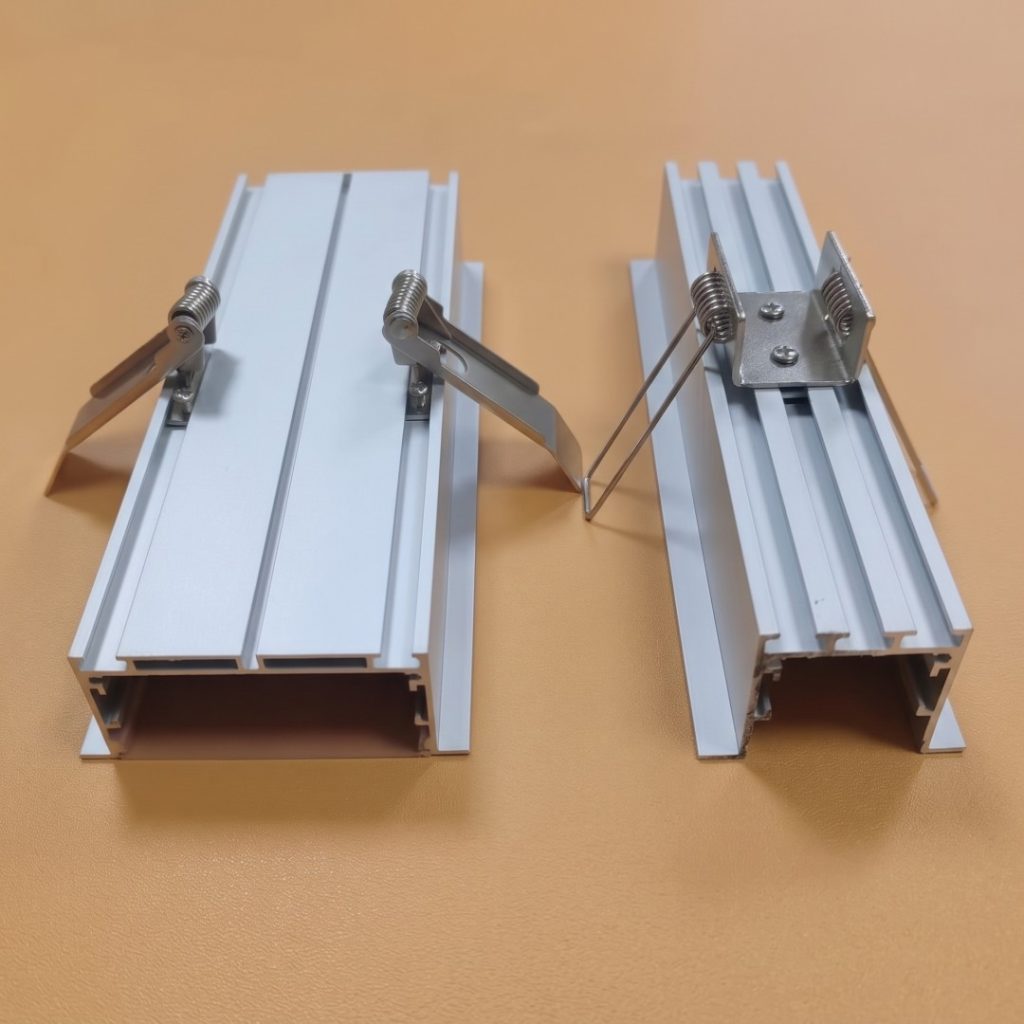
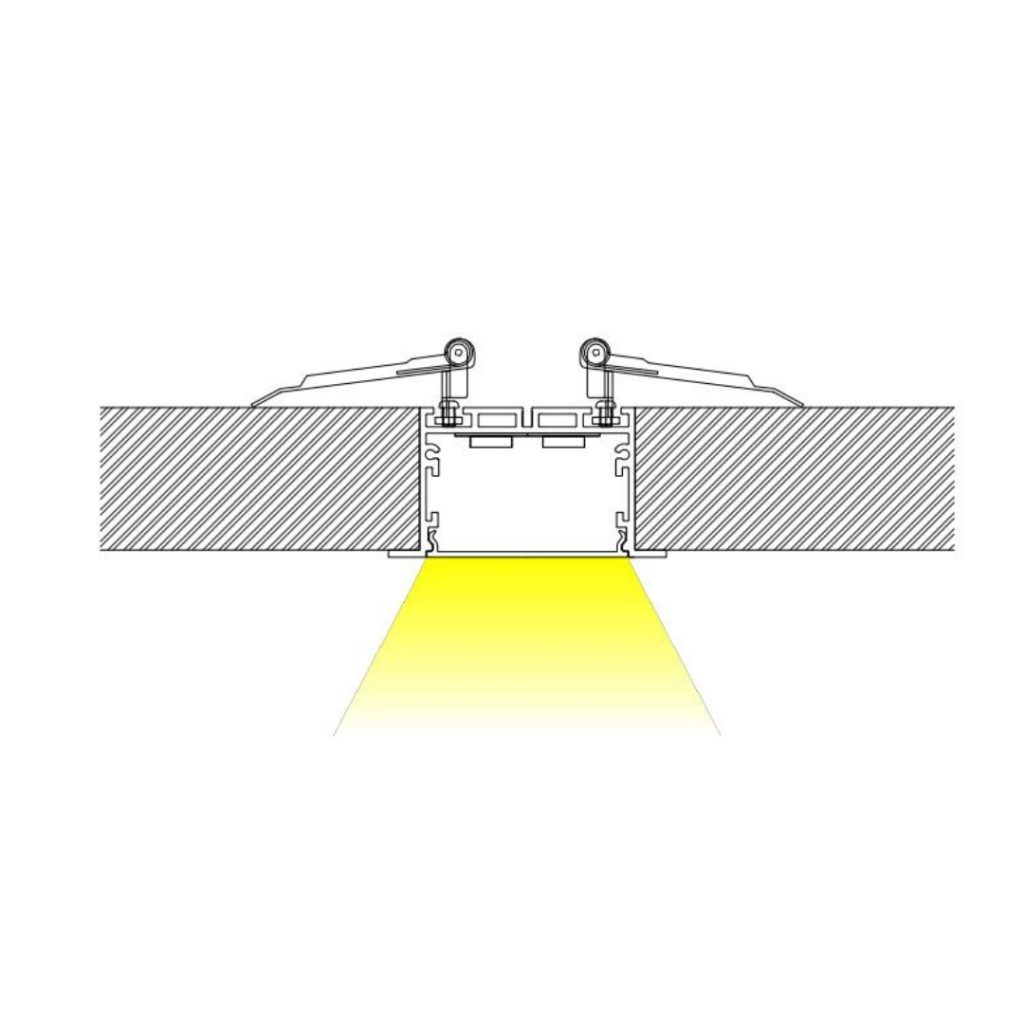
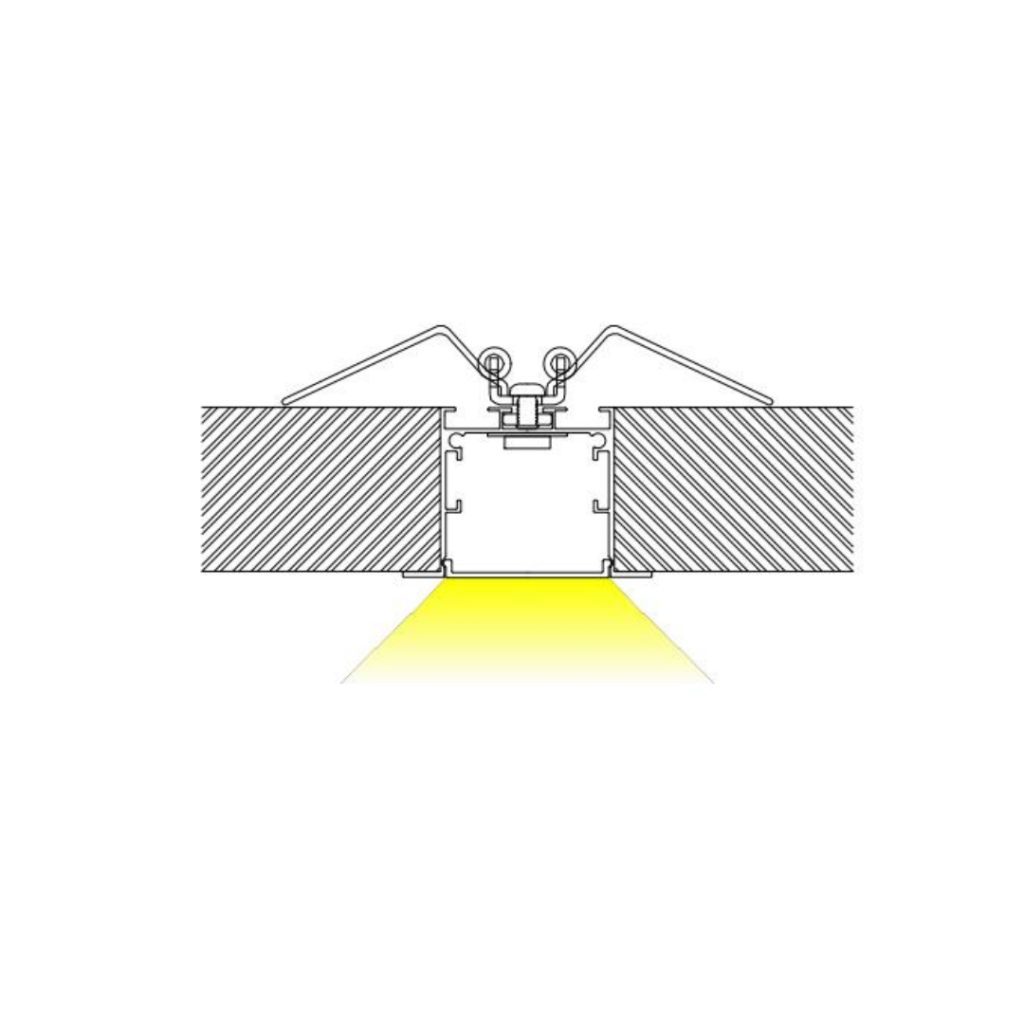
Spring clips are mainly used for recessed LED aluminum profiles installed in ceilings, walls or other cut openings.
They use spring pressure to hold the profile in place without visible screws.
Single-Side and Double-Side Spring Clips
Spring clips are available in different structures.
| Type | Structure | Application |
|---|---|---|
| Single-side spring clip | Spring structure on one side | Specific recessed profile designs |
| Double-side spring clip | Spring structures on both sides | Profiles requiring support from both sides |
The correct type depends on the profile structure and installation opening.
Spring clip dimensions are also important. Common factors include:
- Clip width.
- Clip height.
- Spring position.
- Spring force.
- Compatible profile dimensions.
- Ceiling or panel thickness.
A clip that is too small may not hold the profile securely. A clip that is too large may make installation difficult.
Why Are Spring Clips Used for Recessed LED Profiles?
Spring clips are popular for recessed lighting because they offer several practical advantages:
- No visible fixing screws.
- Fast installation.
- Secure fixing through spring pressure.
- Suitable for plasterboard ceilings and similar installation structures.
- A cleaner appearance after installation.
They are especially useful for recessed LED profiles where a neat finish is important.
Spring Clip Holding Force and Maintenance
A strong spring clip can hold a recessed LED profile securely. However, stronger fixing does not always mean better installation.
In some plasterboard ceilings, there may be no access to the space above the ceiling. If the profile needs to be removed for maintenance, a strong spring clip can make removal difficult.
This is an important point when selecting spring clips.
For installations that may require future maintenance, consider the balance between holding force and ease of removal.
Important: A spring clip should provide enough holding force without making future maintenance unnecessarily difficult.
LED Profile Connectors
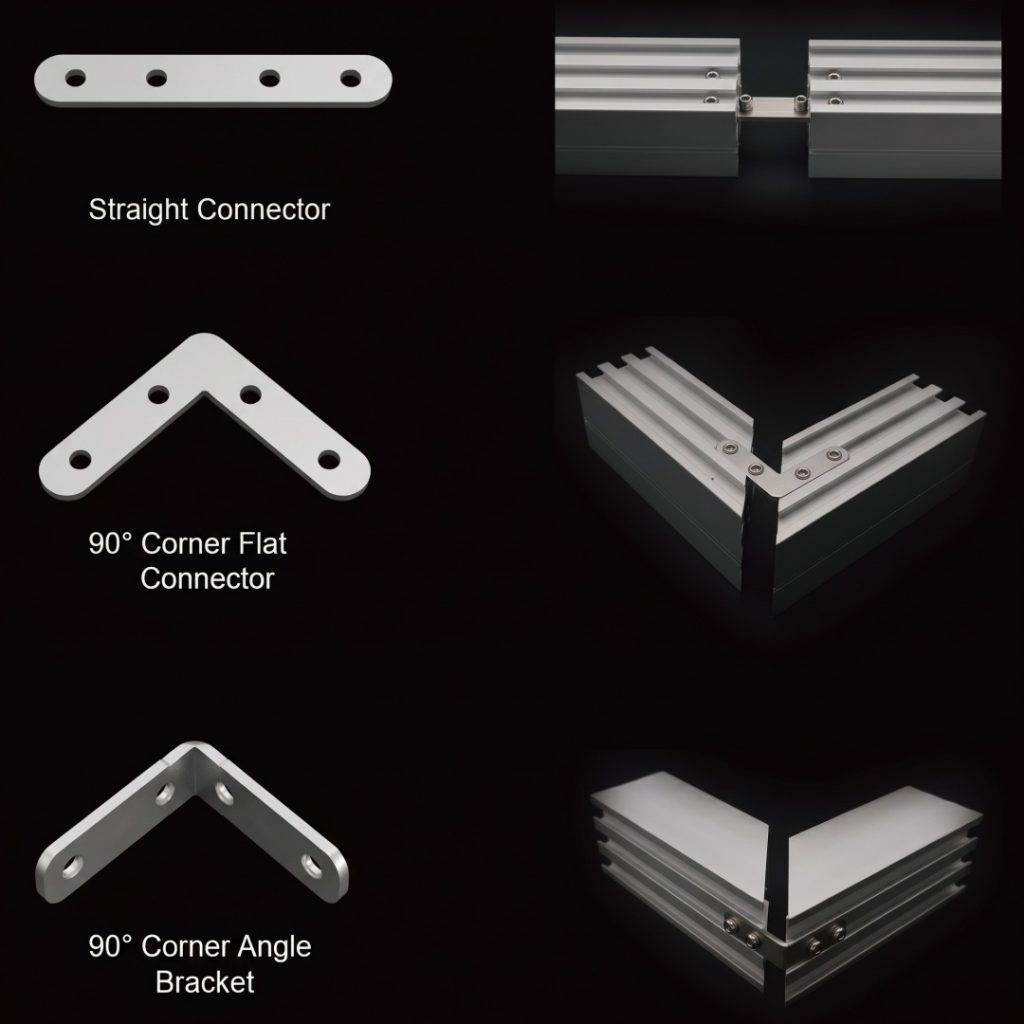
LED profile connectors are used to join two or more aluminum profiles.
They are commonly used for linear lighting systems, long installations and corner connections.
Metal connectors with hex screws are a common solution for traditional aluminum profile designs.
Common Types of LED Profile Connectors
| Connector Type | Angle | Application |
|---|---|---|
| Straight connector | 180° | Joining two profiles in a straight line |
| L-shaped connector | 90° | Creating a corner connection |
| T-shaped connector | 90° | Creating a T-shaped profile layout |
The connector structure must match the internal space and fixing design of the aluminum profile.
What Affects Connector Strength?
The strength of a metal connector depends on more than the material itself.
Several factors should be considered:
| Factor | Why It Matters |
|---|---|
| Connector thickness | Affects stiffness and resistance to bending |
| Connector size | Determines the contact area and fixing space |
| Screw quantity | Affects the stability of the connection |
| Screw position | Influences how the load is distributed |
| Profile design | Determines whether the connector can be properly installed |
For projects with higher mechanical loads, the complete connection should be tested under the actual installation conditions.
A properly designed connector helps improve the stability of the assembled lighting system.
LED Profile Suspension Kits
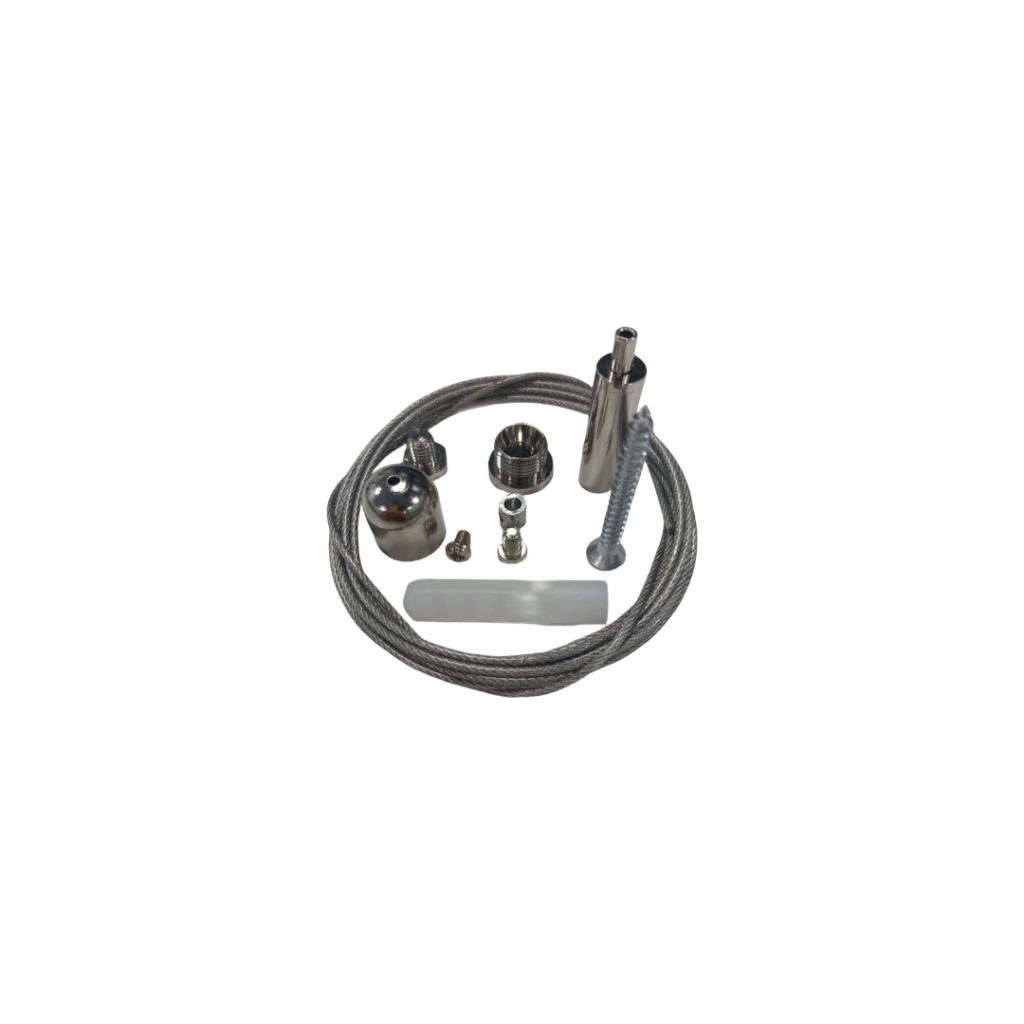
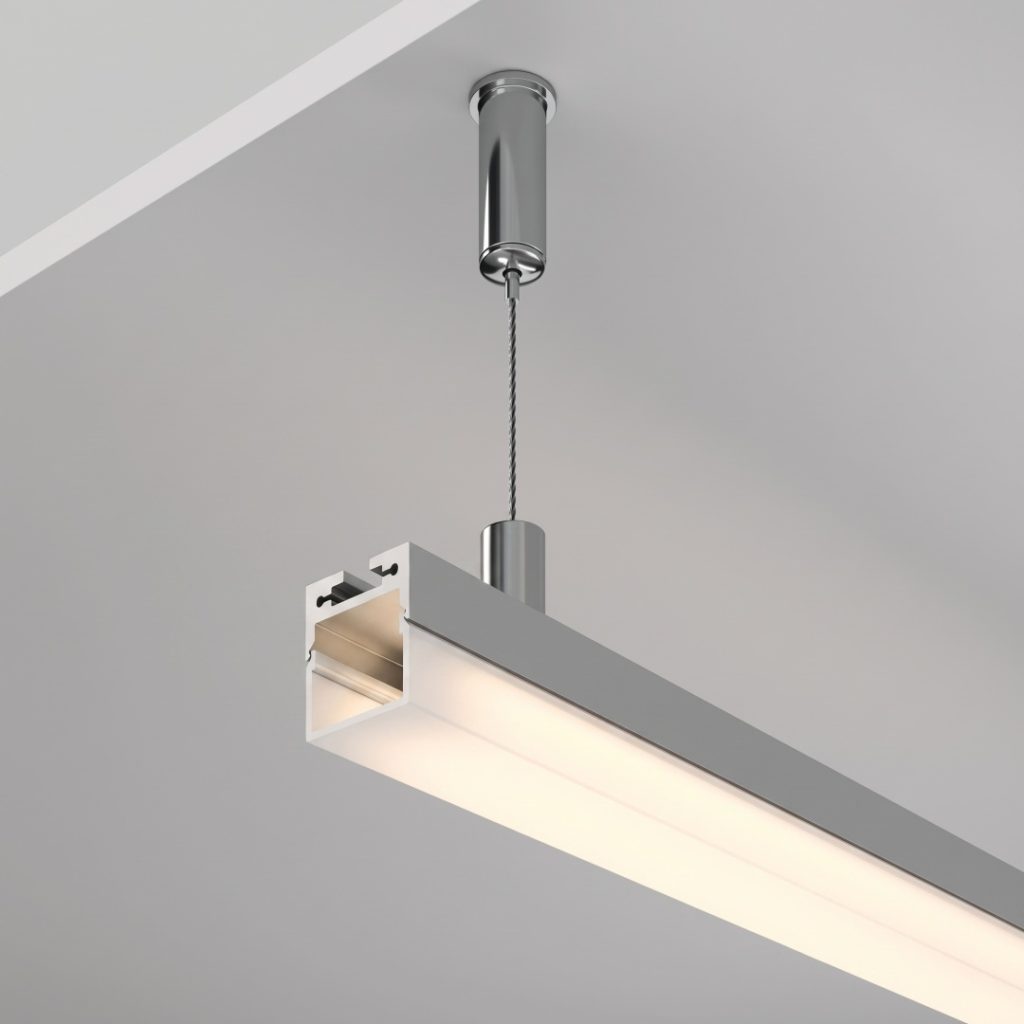
Some LED aluminum profiles are designed to be suspended from the ceiling, especially linear lighting systems.
A suspension kit usually includes several components.
| Accessory | Function |
|---|---|
| Suspension cable | Supports the aluminum profile |
| Suspension bracket | Connects the cable to the profile |
| Cable gripper | Adjusts the suspension height |
| Ceiling fixing | Connects the suspension system to the ceiling |
When selecting a suspension kit, consider the profile structure, installation height, suspension points and total load.
The suspension accessories must be suitable for the profile design and the required installation conditions.
Do All LED Profiles Need Mounting Clips?
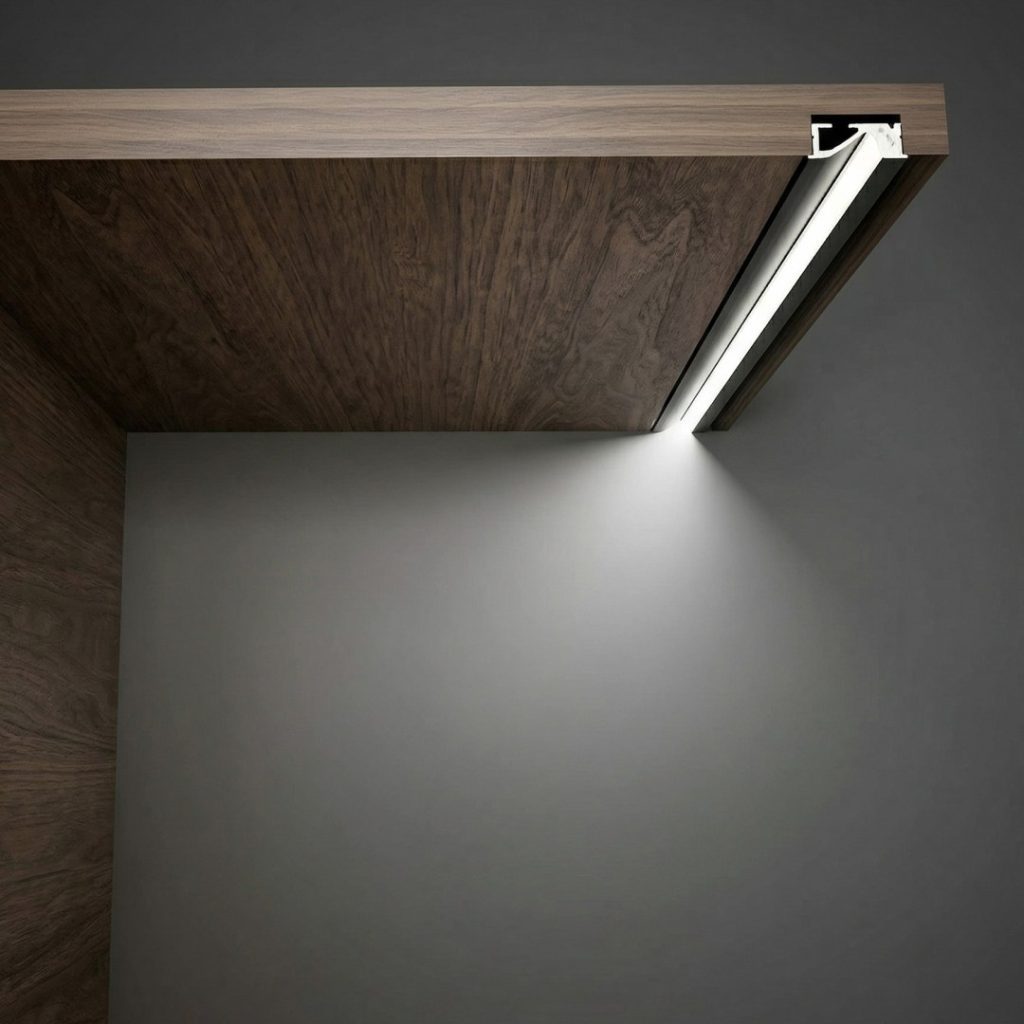
Not every LED aluminum profile requires a separate mounting clip.
Some small recessed profiles and under-cabinet lighting profiles are designed for direct installation.
Common fixing methods include:
| Fixing Method | Application |
|---|---|
| Screw fixing | Profiles with suitable screw holes or fixing structures |
| Adhesive fixing | Applications where the mounting surface allows adhesive installation |
| Friction fit | Profiles designed to fit tightly into a matching installation opening |
For example, some small cabinet lighting profiles can be fixed with screws, adhesive or a suitable friction-fit structure.
The correct method depends on the profile design, installation opening and application.
Before choosing an installation method, check whether the profile is designed for additional clips or direct fixing.
LED Aluminum Profile Accessories Compatibility
Accessory compatibility is one of the most important factors when purchasing LED aluminum profiles.
Not all accessories are universal. Even if two aluminum profiles look similar, their end caps, diffusers, clips and connectors may not be interchangeable.
Small differences in dimensions or fixing structures can cause assembly problems.
Why Are Accessories Not Always Universal?
Each accessory needs to match the correct profile dimensions and structure.
| Accessory | Important Dimensions or Features |
|---|---|
| End caps | Profile cross-section, internal dimensions and fixing positions |
| PC diffusers | Opening width, groove structure and diffuser thickness |
| Mounting clips | Bottom width, fixing grooves and clip position |
| Spring clips | Profile opening, spring dimensions and installation depth |
| Connectors | Internal space, screw positions and connector dimensions |
For this reason, it is usually safer to use accessories designed and tested for the same profile system.
Dimensional Tolerances Matter
An LED aluminum profile system usually includes three main components:
- Aluminum profile.
- PC diffuser.
- Plastic or metal accessories.
Their dimensions must be controlled together to ensure proper assembly.
For example:
| Assembly Problem | Possible Result |
|---|---|
| End cap is too tight | Difficult to install or cannot fit properly |
| End cap is too loose | Requires additional glue or may fall off |
| Diffuser is too tight | Difficult installation or possible damage |
| Diffuser is too loose | May become loose or fall out |
| Clips do not match | Profile cannot be fixed correctly |
| Different batch dimensions | Inconsistent assembly between orders |
These problems may appear small, but they can increase installation time and labor costs.
For example, an inexpensive end cap may require extra manual work if it does not fit correctly. When this happens across hundreds or thousands of profiles, the additional labor cost can become much higher than the accessory cost itself.
Good dimensional control helps reduce assembly problems, installation time and after-sales issues.
Why Should You Buy Accessories From the Same Supplier?
For long-term supply, using accessories designed for the same profile system has several advantages:
- Profile and accessory dimensions can be checked together.
- Diffuser and end cap compatibility can be tested before production.
- Production tolerances can be controlled across different batches.
- Replacement accessories are easier to match with previous orders.
- The risk of assembly problems can be reduced.
For distributors and wholesalers, consistent product dimensions are especially important when ordering the same models repeatedly.
How to Order LED Aluminum Profile Accessories
The required accessory quantities can vary from one project to another.
Some customers need only end caps, while others need complete sets including profiles, diffusers, clips and connectors.
Individual Accessories or Complete Kits?
| Purchasing Method | Quotation Method | Suitable Customers |
|---|---|---|
| Individual accessories | Priced separately according to accessory type and quantity | Distributors, wholesalers and project buyers |
| Complete LED profile kits | Quoted as a complete set | Retailers, brands and end users |
For individual accessory orders, each item is usually calculated separately because different projects require different quantities.
For complete retail kits, the aluminum profile, PC diffuser and required accessories can be packed and quoted together.
What Information Is Needed for a Quotation?
To select the correct LED aluminum profile accessories, it is helpful to provide:
| Required Information | Purpose |
|---|---|
| Profile model or technical drawing | To check the profile structure |
| Required accessory type | To identify the correct components |
| Quantity | To prepare the quotation |
| Material and color | To confirm the production requirements |
| Application | To understand the installation method |
| Photos or physical samples | To check compatibility |
If you are not sure which accessories fit your LED aluminum profiles, you can send us the profile drawing, photos or samples for compatibility checking.
Conclusion
LED aluminum profile accessories are small components, but they have a direct impact on product appearance, installation efficiency and long-term product quality.
From plastic and aluminum end caps to mounting clips, spring clips, connectors and suspension kits, each accessory should be selected according to the profile structure and application.
For distributors, wholesalers and lighting manufacturers, choosing compatible accessories and maintaining consistent dimensions across production batches can help reduce installation problems and improve the overall product system.
At LEDLINEA, we support LED aluminum profile supply, accessory selection and OEM customization for different lighting applications. Contact us with your drawings, samples or project requirements to discuss suitable profile and accessory solutions.