Standard LED aluminum profiles are suitable for many lighting applications. However, some OEM lighting projects require additional features to meet specific thermal, mechanical or installation requirements.
Depending on the application, a custom aluminum extrusion may incorporate cooling ribs, dedicated mounting grooves, cable-routing channels or specially designed connector interfaces. These features should be considered together with the LED strip, diffuser, mounting method and required assembly tolerances.
Cooling Fins and Thermal Design
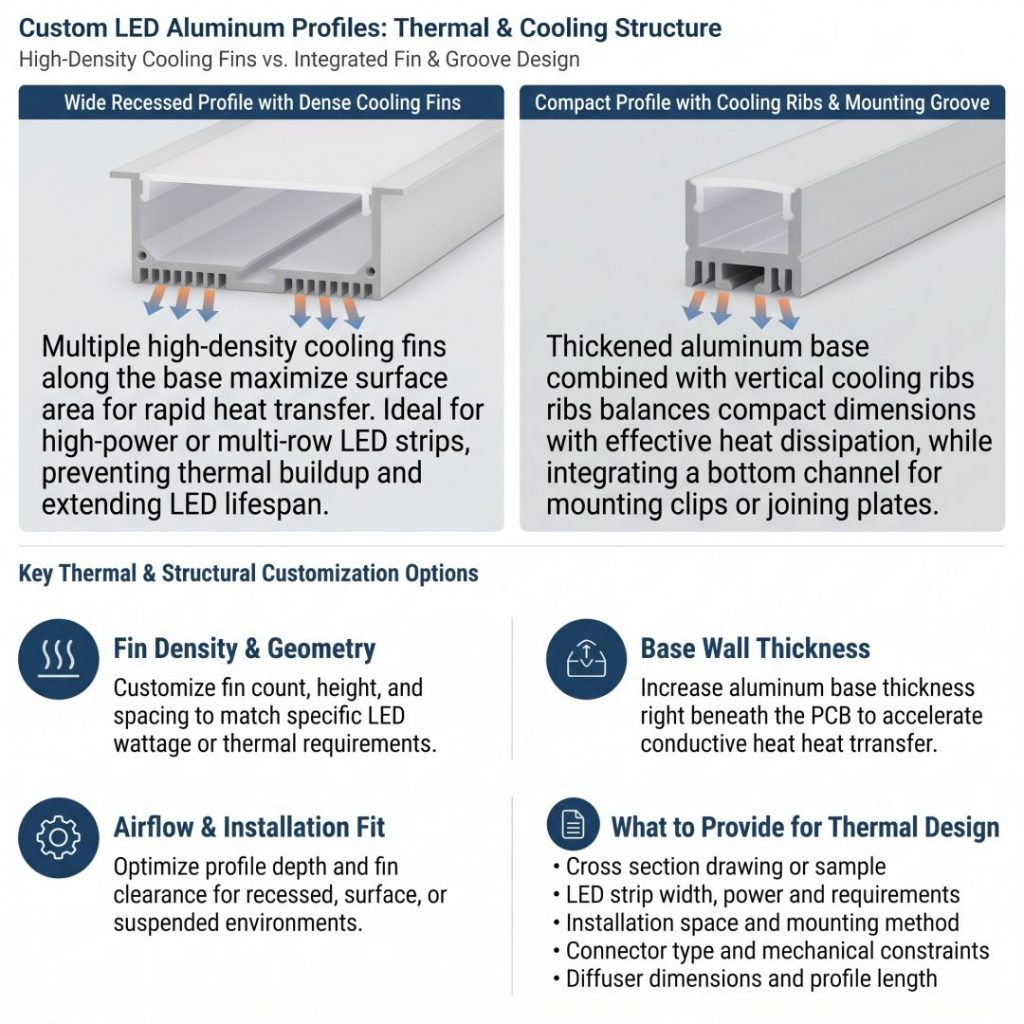
When the LED strip’s power output, available installation space or temperature requirements exceed what a standard profile can accommodate, additional thermal design features may be worth evaluating.
Possible modifications include:
- Adding cooling fins or ribs to the underside of the aluminum profile
- Adjusting the thickness of the base to improve heat spreading
- Modifying the cross-section to increase the available heat-dissipation surface
- Reviewing the contact between the LED strip and the aluminum base
Adding more cooling fins does not automatically guarantee better thermal performance. The actual result depends on the fin geometry and spacing, mounting orientation, airflow, LED strip power and thermal contact between the strip and the aluminum profile.
For OEM projects, the cross-section should be evaluated against the actual operating conditions rather than selected by appearance alone.
Connector Design: Metal Joining Plates vs. Plastic Connectors
The connector interface is another important consideration when developing a custom LED aluminum profile.
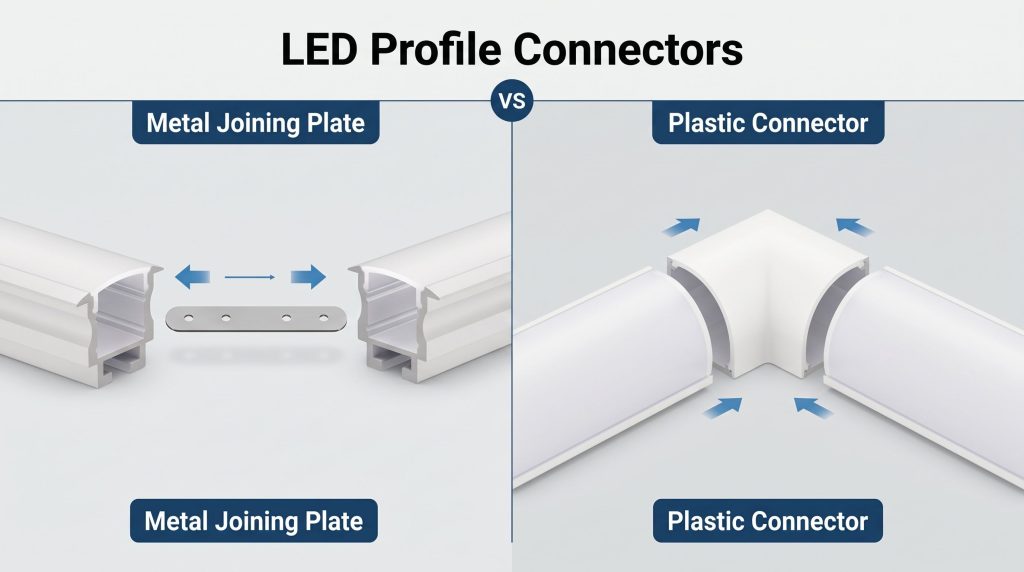
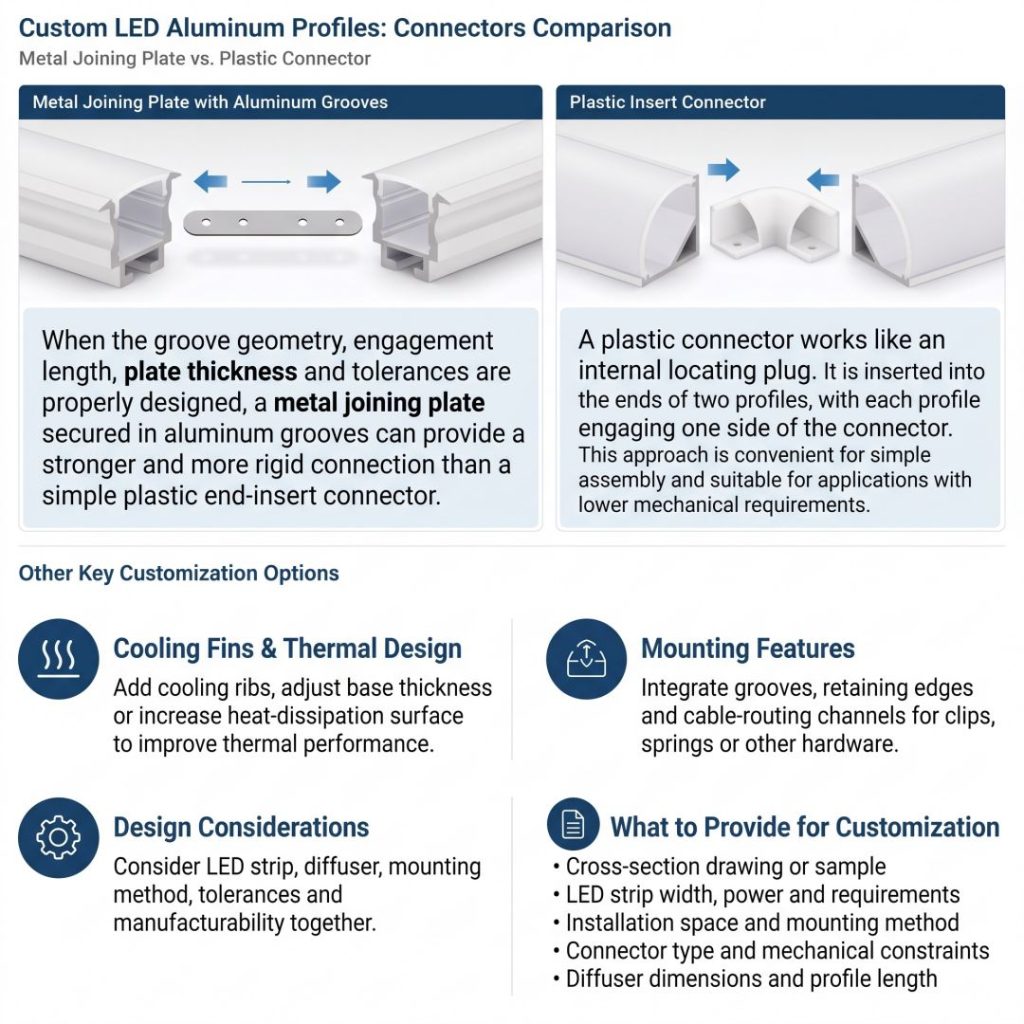
Depending on the required assembly method, a profile may use a metal joining plate inserted into dedicated grooves, or a plastic connector that fits into the ends of two profiles.
Metal Joining Plates with Aluminum Grooves
A metal joining plate can engage with specially designed grooves in the aluminum profiles to align and connect adjacent sections.
When the groove geometry, engagement length, plate thickness and tolerances are properly designed, a metal joining plate secured in aluminum grooves can provide a stronger and more rigid connection than a simple plastic end-insert connector. This can be particularly relevant when the joint must resist movement or maintain alignment between connected profile sections.
However, actual joint strength depends on the complete design, including the metal plate material, groove geometry, engagement depth, fasteners if used, and the loads applied to the assembly.
Plastic Insert Connectors
A plastic connector may work like an internal locating plug. It is inserted into the ends of two profiles, with each profile engaging one side of the connector. The connector’s shape and interference fit help hold the sections together and maintain alignment.
This approach can be convenient for simple assembly and may be suitable for applications where the required joint strength and rigidity are relatively modest.
Its performance depends on the plastic material, connector geometry, fit tolerance, insertion depth and operating conditions.
The two connection methods are therefore not interchangeable in every application. The appropriate solution depends on the mechanical requirements, assembly process and intended use of the lighting system.
Integrating Mounting Features into the Extrusion
If an OEM project requires clips, spring clamps or other dedicated mounting hardware, the corresponding interfaces should be considered during the cross-section design stage.
Potential features include:
- Dedicated grooves for mounting clips or joining plates
- Retaining edges for mechanical engagement
- Reinforced sections where additional rigidity is required
- Cable-routing channels integrated into the profile
- Adjusted wall thickness to balance structural requirements and extrusion feasibility
Simply adding protruding feet or ribs to an existing profile does not guarantee compatibility with a connector or mounting clip. The relevant dimensions, wall thickness, tolerances and assembly clearances must be designed together.
A custom extrusion can integrate multiple functions into a single cross-section, but manufacturability and assembly reliability should be reviewed before finalizing the design.
What Should Be Confirmed Before Developing a Custom Profile?
To evaluate a custom LED aluminum profile, the following information is useful:
- Cross-section drawing or reference sample
- LED strip width, power and operating requirements
- Available installation space and mounting method
- Required connector type and mechanical constraints
- Diffuser dimensions and retention method
- Required profile length, finish and expected order quantity
These details help determine whether an existing profile can meet the requirements or whether a modified extrusion should be considered.
Can LED Aluminum Profiles Be Customized for OEM Applications?
When a standard LED aluminum profile does not meet specific thermal, mechanical or installation requirements, a custom extrusion may offer more design flexibility.
Depending on the project, the cross-section can be adapted to accommodate cooling ribs, mounting grooves, cable-routing channels or dedicated connector interfaces.
For OEM lighting products, the goal is not simply to add more features. It is to develop a profile that balances thermal performance, connection strength, installation requirements and extrusion feasibility.
Need a customized LED aluminum profile? Share your cross-section drawing, LED strip specifications, installation space and connector requirements to discuss the feasibility of a custom design.
LEDLINEA supplies LED aluminum profile solutions for lighting brands, distributors and OEM applications.